
Important points
- Lacks a well-defined nucleus, i.e. the nuclear envelope is absent.
- The circular, double-stranded genetic material (nucleoid) floats in the cytoplasm of the cell.
- Chromatin, nucleolus and histone proteins are absent.
- Packing of DNA is performed by positively charged polyamines.
- Lacks membrane-bound cell organelles like mitochondria, plastids, ER, etc.
- Ribosomes of the 70S type are present.
- Gas vacuoles/ pseudovacuoles are present.
- Size is smaller than eukaryotic cells.
- A single envelope system is present.
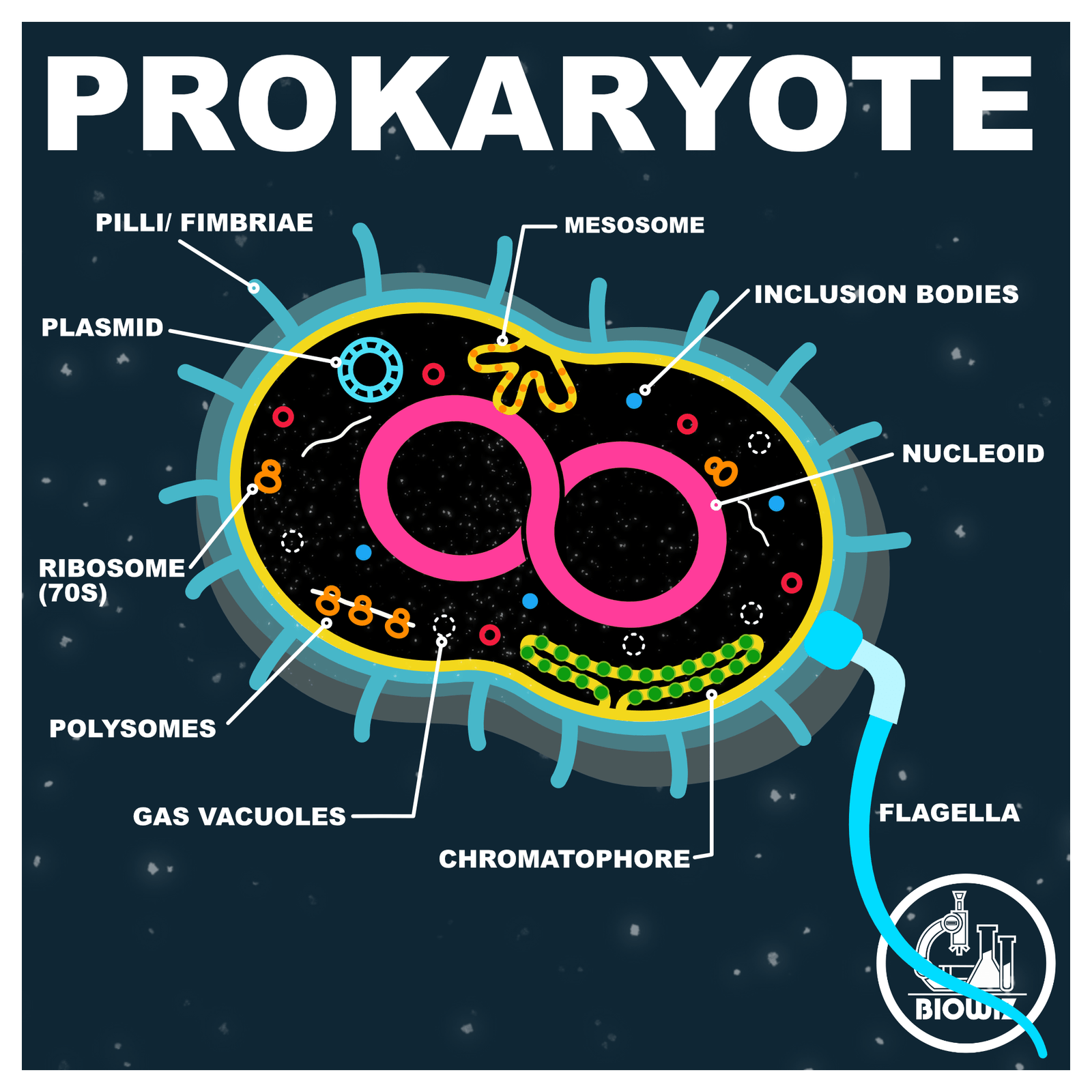
NCERT’s examples of prokaryotic cells are bacteria, blue-green algae (cyanobacteria), mycoplasma and PPLO (pleuro-pneumonia-like organisms). Most bacteria are 1–2 µm in size, while PPLO are the smallest cells, about 0.1 µm.
Parts of a prokaryotic cell
Cell envelope
Made up of 3 layers:
Glycocalyx
- Gelatinous layer made up of carbohydrates.
- Exists in 2 forms in prokaryotes, i.e. the slime layer and the capsule.
- Slime layer – present as a loose sheath; prevents desiccation of the cell.
- Capsule – tightly attached to the cell wall; protects bacteria from the immune system of the host; responsible for the pathogenicity of the bacteria.
Cell wall
- Archaebacteria have a cell wall made up of pseudopeptidoglycan (a polymer of N-acetylglucosamine and N-acetyltalosaminuronic acid).
- The eubacterial cell wall is made up of peptidoglycan (a polymer of N-acetylglucosamine and N-acetylmuramic acid).
- Mycoplasma lacks a cell wall.
Cell membrane
- The structure of the cell membrane is the same as that in eukaryotic cells.
The three layers of the cell envelope act together as a single protective unit. Based on differences in the cell envelope and their response to Gram staining, bacteria are classified as Gram-positive (take up the stain) and Gram-negative (do not).
Cellular projections
Flagella
- Made up of helically arranged flagellin protein.
- Help in locomotion.
Pili
- Made up of pilin protein.
- Longer, fewer in number.
- Help in the transfer of DNA from one bacterium to another (conjugation).
Fimbriae
- Made up of pilin protein.
- Short, more in number.
- Help in attachment to a surface.
A bacterial flagellum has three parts: the filament (the longest part, extending outside the cell), the hook and the basal body.
Nucleoid
- Also known as the incipient nucleus/ genophore/ prochromosome.
- Double-stranded circular DNA is the genetic material in prokaryotes.
Mesosome
- Formed by the invagination of the cell membrane.
- Helps in respiration, DNA replication, cell division, secretion of substances, etc.
Mesosomes occur as vesicles, tubules and lamellae. They also help in cell wall formation and in distributing DNA to the daughter cells, and they increase the surface area of the plasma membrane and its enzymatic content.
Chromatophores
- Pigment-containing structures.
- Present in photosynthetic bacteria and blue-green algae.
Plasmid
- Extra-chromosomal, self-replicating, circular dsDNA.
- Provides additional features to the cell, e.g. antibiotic resistance.
Ribosomes
- 70S-type ribosomes are present in prokaryotes.
- Made up of two subunits – 50S and 30S.
- Perform the function of protein synthesis.
Several ribosomes may attach to a single mRNA to form a chain called a polysome (polyribosome). The ribosomes of a polysome translate the mRNA into proteins.
Inclusion bodies
- Aggregates of molecules present in the prokaryotic cell.
- Act as storage structures.
- Types – phosphate granules, cyanophycean granules, glycogen granules, gas vacuoles, etc.
Gas vacuoles
- A type of inclusion body.
- Also known as pseudovacuoles.
- Present in photosynthetic bacteria and blue-green algae.
- Provide buoyancy to the cell.