
What is the electron transport system?
ETC or electron transport chain refers to the series of electron carriers present in a membrane through which electrons flow. This flow of electrons through the electron carriers is responsible for creating a proton gradient required for the formation of ATP.
Mitochondria, which are the major site of ATP formation, depend on the ETC. The electron carriers are embedded in the inner mitochondrial membrane in the form of enzyme complexes. The enzyme complexes are:
- Complex I – NADH dehydrogenase
- Complex II – succinate dehydrogenase
- Complex III – cytochrome b-c1 complex or cytochrome c reductase
- Complex IV – cytochrome a-a3 complex or cytochrome c oxidase
- Complex V – ATP synthase
These enzyme complexes oxidise the NADH + H+ and FADH2 produced in the mitochondrial matrix during the tricarboxylic acid cycle (TCA cycle). This oxidation releases electrons, which flow through the enzyme complexes.
The flow of electrons from one enzyme complex to another is facilitated by mobile electron carriers present in the membrane. These mobile electron carriers are:
- Ubiquinone (UQ)/ coenzyme Q – lipid-soluble, freely diffusible in the lipid bilayer.
- Cytochrome c – soluble protein towards the peri-mitochondrial side.
Role of enzyme complexes
Complex I – NADH dehydrogenase
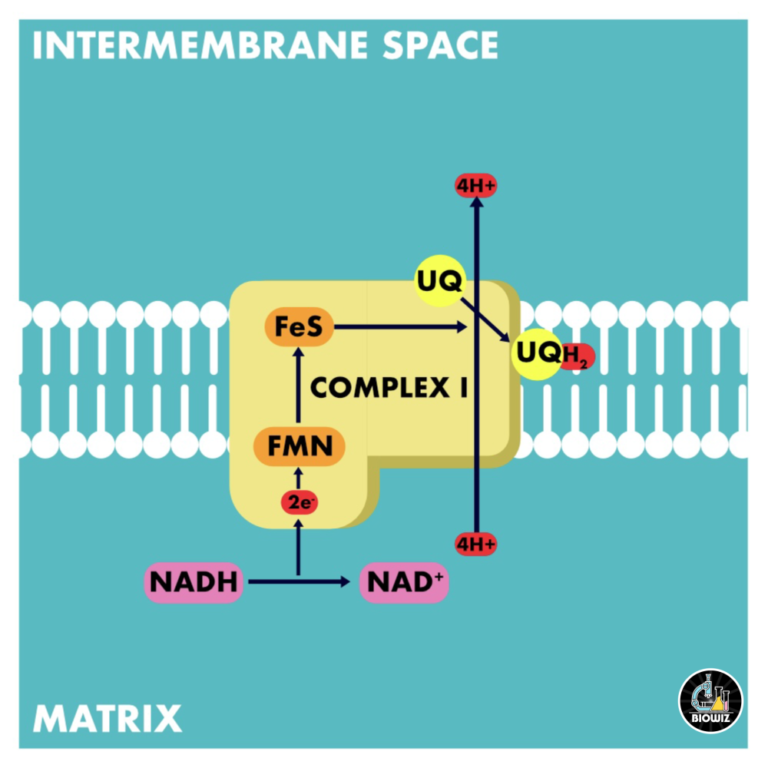
- Complex I is a large, L-shaped enzyme complex and consists of several groups, like FMN (flavin mononucleotide) and multiple Fe-S centres.
- NADH dehydrogenase performs two processes:
- It oxidises the NADH + H+ from the matrix side, which releases 2 electrons and 2 protons. These 2 electrons and protons are captured by ubiquinone (UQ), which gets reduced into ubiquinol (UQH2).
- It also acts as a proton pump and uses the energy of the electrons to transfer 4H+ from the matrix (N-side) to the peri-mitochondrial space (P-side).
Overall reaction:
NADH + 5H+ (N-side) + UQ → NAD+ + UQH2 + 4H+ (P-side)
The reduced UQH2 diffuses from complex I to complex III and gets oxidised to UQ.
Complex II – succinate dehydrogenase
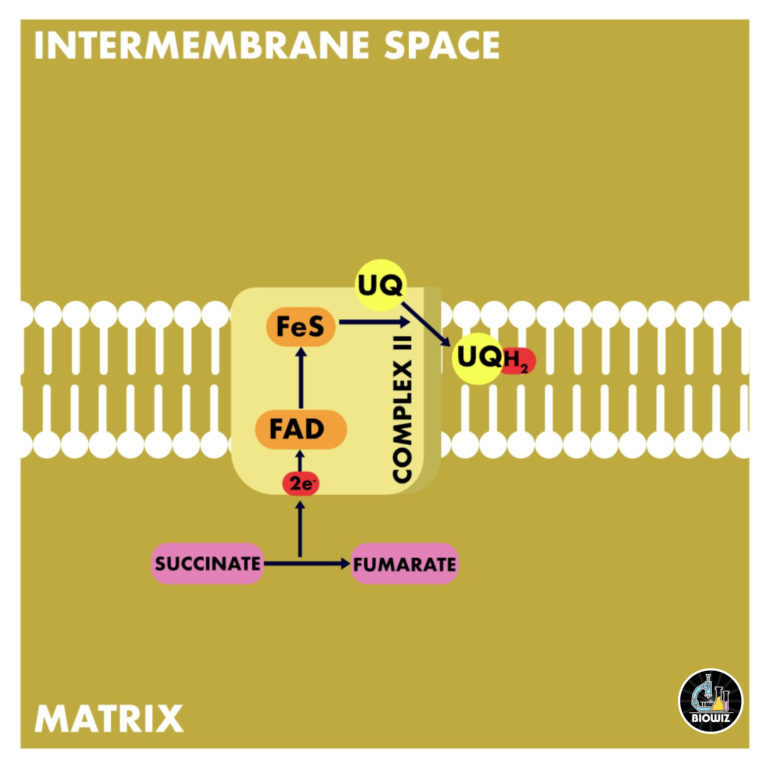
- Complex II is the only membrane-bound enzyme of the TCA cycle. It consists of 3 Fe-S centres, a bound FAD and a succinate-binding site towards the matrix.
- Succinate is oxidised to fumarate during the TCA cycle, and it transfers 2 electrons and 2 protons to the FAD bound to succinate dehydrogenase. This reduces FAD into FADH2, which further transfers these electrons and protons to UQ and reduces it into UQH2.
Overall reaction:
FADH2 + UQ → FAD + UQH2
The reduced UQH2 diffuses from complex II to complex III and gets oxidised to UQ.
Complex III – cytochrome b-c1 complex
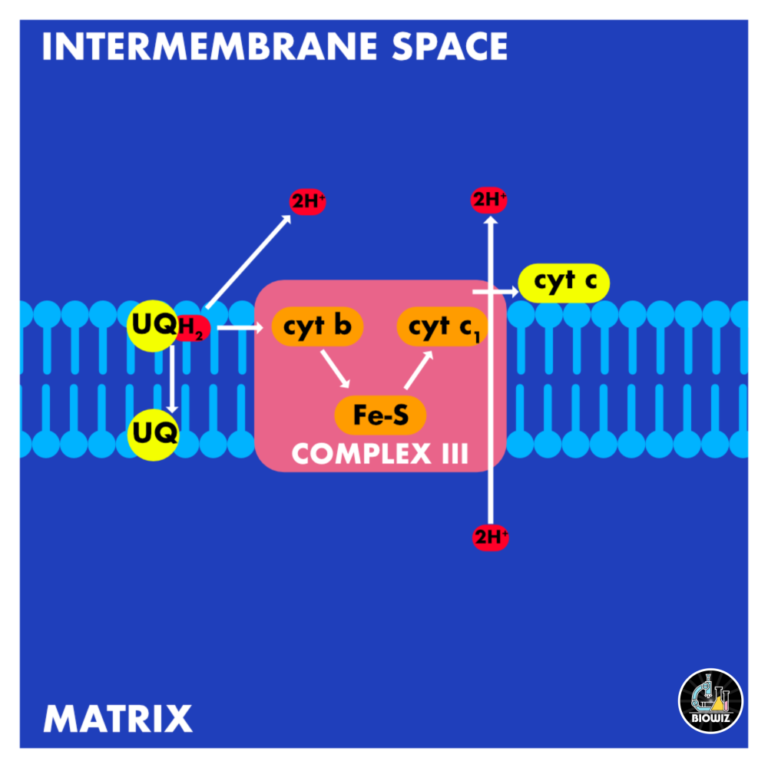
- The cytochrome bc1 complex consists of a cyt b group, 2 Fe-S centres and a cyt c1 group.
- It receives electrons from the UQH2 reduced by complexes I and II and oxidises it to UQ. These electrons are then transferred through cyt b – Fe-S – cyt c1 and ultimately reduce two molecules of cyt c.
- During this flow of electrons, two protons are pumped from the matrix (N-side) to the peri-mitochondrial space (P-side), and two protons are released by the reduced UQH2 into the peri-mitochondrial space. As a result, the oxidation of one UQH2 results in the transfer of 4H+ from the N-side to the P-side.
Overall reaction:
UQH2 + 2 cyt c (oxidised) + 2H+ (N-side) → UQ + 2 cyt c (reduced) + 4H+ (P-side)
The reduced cyt c then moves to complex IV.
Complex IV – cytochrome c oxidase
Complex IV consists of two cytochromes – cyt a and cyt a3 – along with two copper centres, CuA and CuB. The oxidation of two cyt c releases two electrons, which are transferred through CuA – cyt a – cyt a3 – CuB. These electrons are finally accepted by the terminal electron acceptor of the ETS, i.e. O2, which gets reduced into H2O.
Complex IV also acts as a proton pump and transfers 2H+ from the matrix (N-side) to the peri-mitochondrial space (P-side) during the flow of 2 electrons from cyt c to O2.
Overall reaction:
2 cyt c (reduced) + 4H+ (N-side) + ½O2 → 2 cyt c (oxidised) + 2H+ (P-side) + H2O
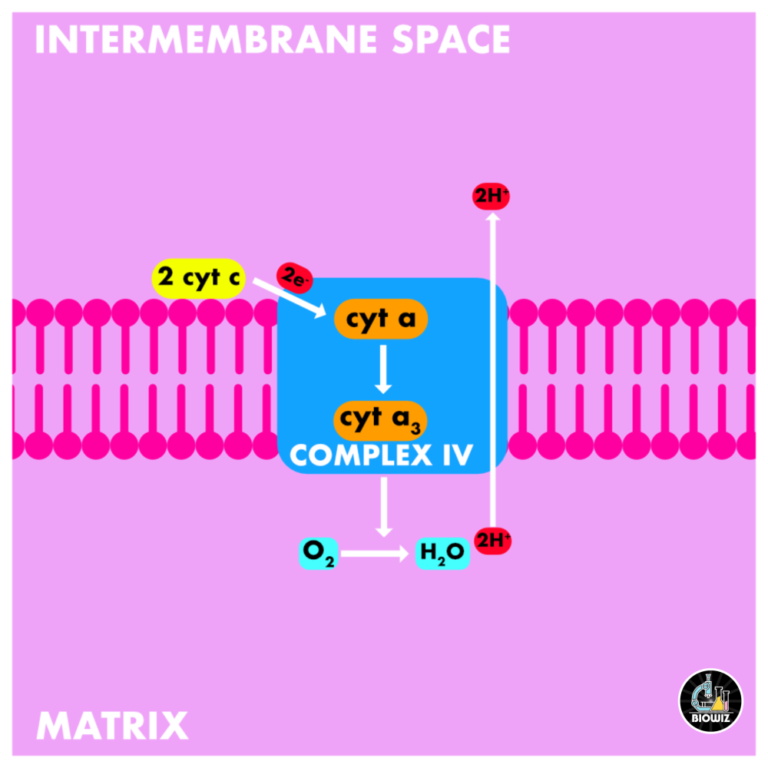
Oxygen is the final hydrogen acceptor of the ETS. Although it acts only at the last step, it drives the whole process by removing electrons and hydrogen from the chain as water. Without oxygen, the ETS stops.
Proton gradient
1. Oxidation of one NADH + H+
Complex I → Complex III → Complex IV → O2
- Complex I – 4H+
- Complex II – not involved
- Complex III – 4H+
- Complex IV – 2H+
Total = 10H+ from the matrix to the peri-mitochondrial space
2. Oxidation of one FADH2
Complex II → Complex III → Complex IV → O2
- Complex I – not involved
- Complex II – zero
- Complex III – 4H+
- Complex IV – 2H+
Total = 6H+ from the matrix to the peri-mitochondrial space
3. The reduction of ½O2 into H2O by the 2 electrons released from either NADH + H+ or FADH2 removes 2H+ from the matrix in the form of H2O.
Complex V – ATP synthase
- The proton gradient created by the flow of electrons through the ETS creates a proton motive force, which has two components:
- the chemical potential energy due to the difference in the concentration of protons in the two regions separated by the membrane.
- the electrical potential energy that results from the separation of charge.
- ATP synthase consists of two parts: F1 and F0. The F1 part has the ATP synthase enzymatic activity, while the F0 part creates a channel for the facilitated diffusion of H+.
- When the proton gradient breaks down, the proton motive force is used for the formation of a high-energy bond between ADP and Pi to form ATP.
- For the formation of one ATP, 4H+ must flow from the peri-mitochondrial space to the matrix through the F0 part of ATP synthase.
- Therefore, net ATP gain from the oxidation of:
- 1 NADH + H+ = 10/4 = 2.5 ATP
- 1 FADH2 = 6/4 = 1.5 ATP
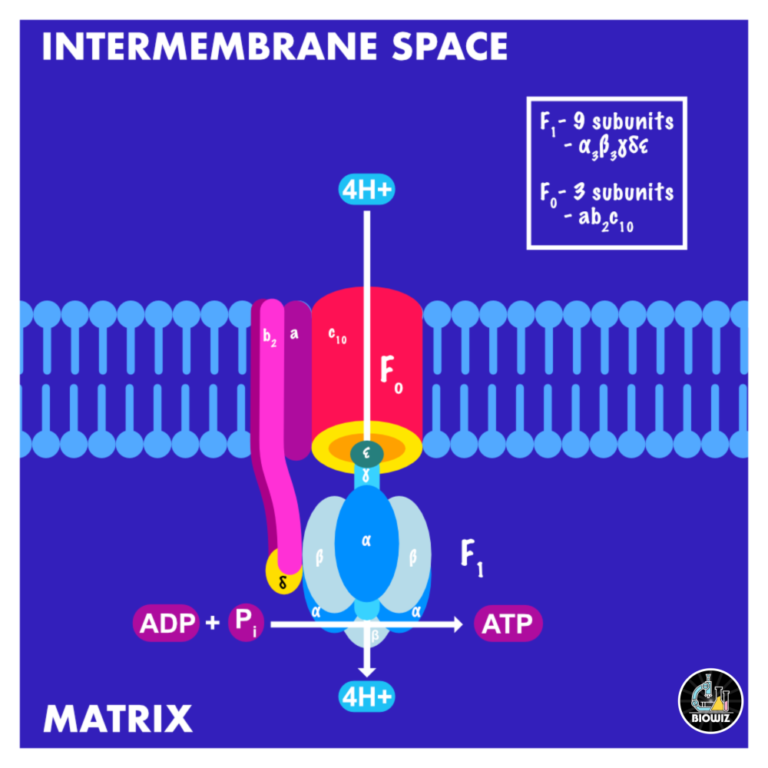
For NEET, follow NCERT’s values: 1 NADH gives 3 ATP and 1 FADH2 gives 2 ATP. The 2.5 and 1.5 values above are the newer, more accurate figures, but NCERT-based questions use 3 and 2. NCERT also calls F1 the headpiece (with the site for ATP synthesis) and F0 the integral membrane part that forms the proton channel.