
What is parenchyma?
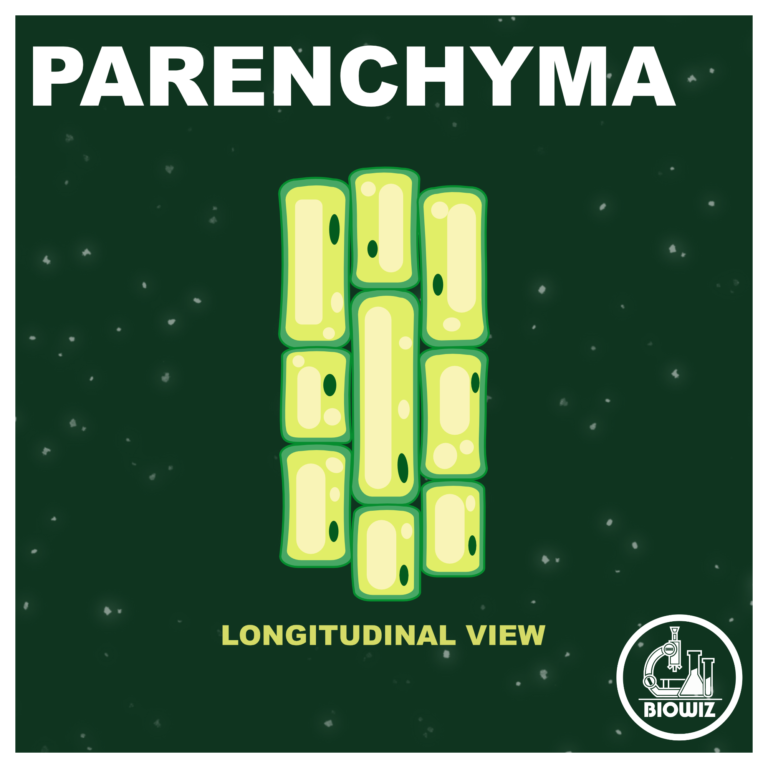
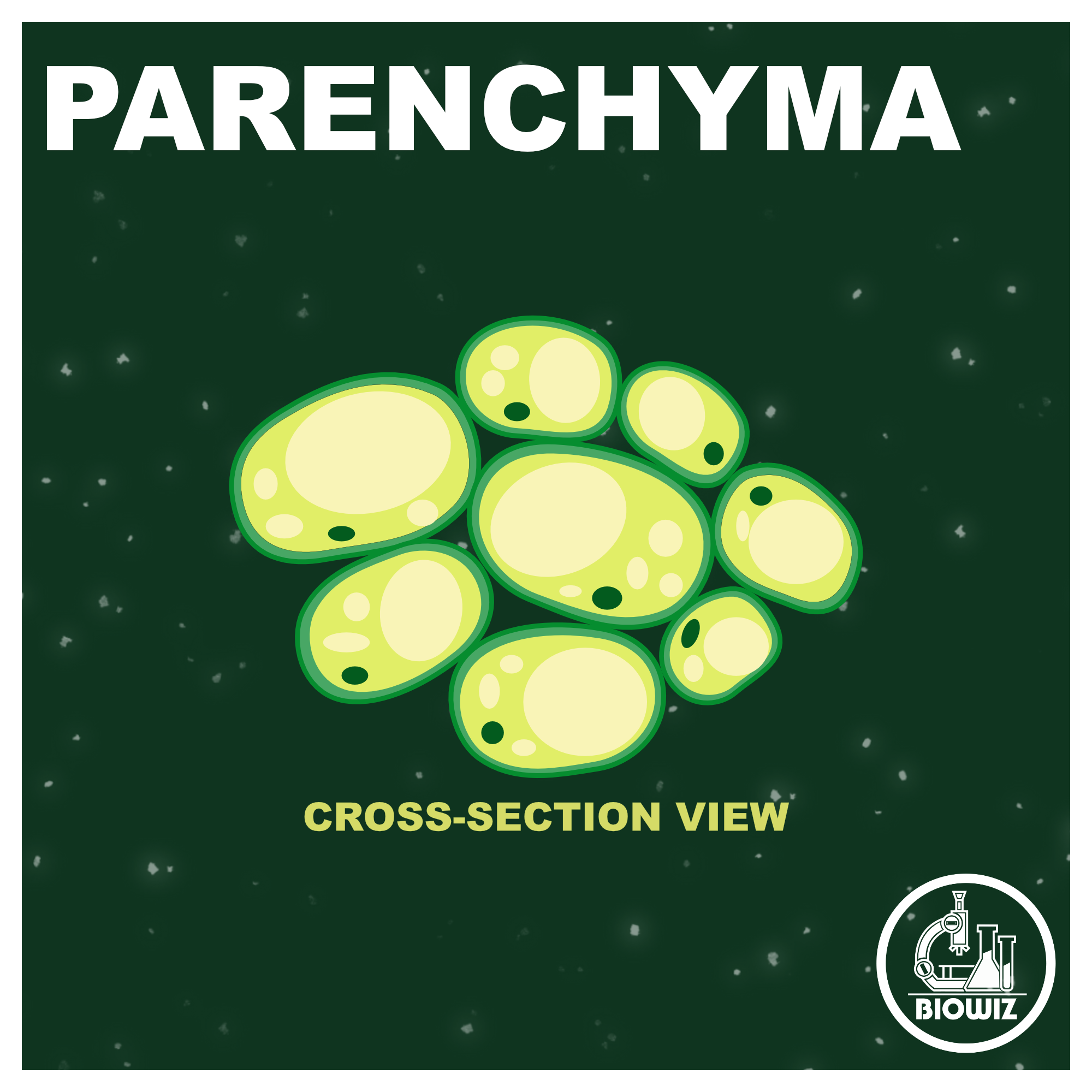
Parenchyma is a simple permanent tissue made up of living, thin-walled cells. It is the most common and least specialised tissue of the plant body, and forms the major component within organs like the stem, root, leaf, fruit and seed.
Features
- Made up of living cells.
- Shape – isodiametric; oval, spherical or polygonal in shape.
- Cells are loosely arranged with large intercellular spaces.
- The cell wall is thin and cellulosic.
- A large, central vacuole is present.
- The nucleus is present and peripherally located.
Functions
- Forms the bulk of the plant body.
- Storage of food.
- Photosynthesis (mesophyll).
- Provides buoyancy in aquatic plants.
- Water storage in fleshy stems and leaves.
- Provides protection (epidermis).
- Helps in secretion and in the lateral conduction of water and food.
Where is parenchyma found?
Parenchyma is found in almost all parts of the plant, including:
- The cortex and pith of stems and roots.
- The mesophyll of leaves.
- The pulp of fruits.
- The endosperm of seeds.
- The xylem and phloem, as xylem parenchyma and phloem parenchyma.
Modified types of parenchyma
- Chlorenchyma – parenchyma cells containing chloroplasts, which carry out photosynthesis. E.g. the mesophyll of leaves.
- Aerenchyma – parenchyma with very large air spaces, which helps aquatic plants to float and supplies air to submerged parts. E.g. Hydrilla, lotus.
- Storage parenchyma – stores food like starch, proteins and oils. E.g. potato tuber, endosperm of cereals.
- Xylem parenchyma – stores food materials (starch, fat) and substances like tannins, and helps in the radial conduction of water.
- Phloem parenchyma – stores food materials and substances like resins, latex and mucilage.
Because parenchyma cells are living, they can regain the ability to divide (dedifferentiation). This is how the interfascicular cambium and the cork cambium arise during secondary growth.
Parenchyma, collenchyma and sclerenchyma
Parenchyma is one of the three simple permanent tissues of plants, along with collenchyma and sclerenchyma.
| Feature | Parenchyma | Collenchyma | Sclerenchyma |
|---|---|---|---|
| Cells | Living | Living | Usually dead |
| Cell wall | Thin, made of cellulose | Thickened at the corners due to cellulose, hemicellulose and pectin | Thick, lignified |
| Intercellular spaces | Present | Absent | Absent |
| Main function | Storage, photosynthesis, secretion | Mechanical support to young stems and petioles | Mechanical strength |
| Absent in | – | Monocots | – |