
What is collenchyma?
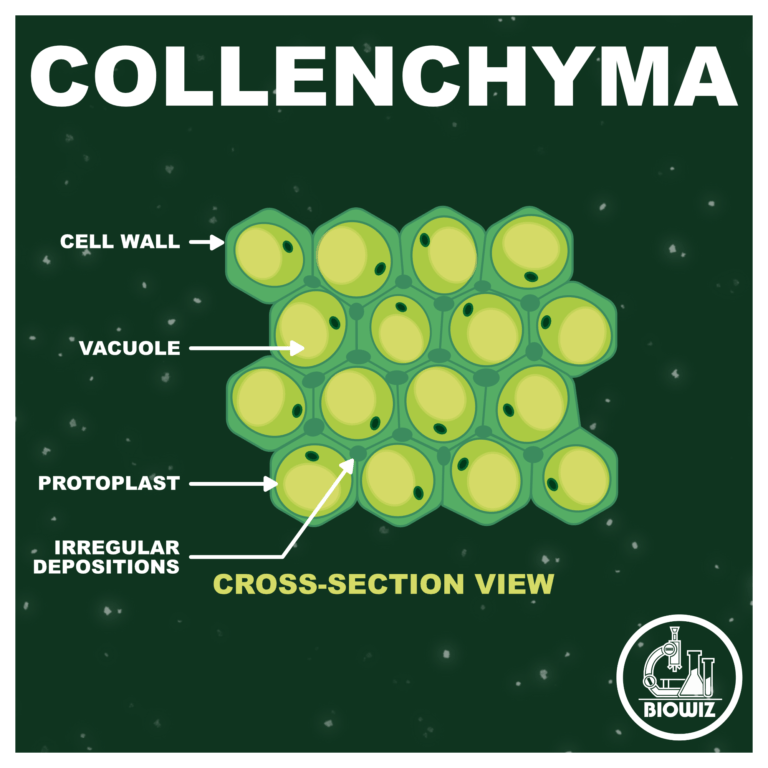
Collenchyma is a simple permanent tissue made up of living cells whose walls are thickened at the corners. It gives mechanical support and flexibility to the growing parts of the plant, such as young stems and petioles of leaves.
Features
- Made up of living cells.
- Shape – elongated.
- Intercellular spaces are absent.
- The cell wall is thin and cellulosic, with irregular thickenings of cellulose and pectin at the corners.
- A large, central vacuole is present.
- The nucleus is present and peripherally located.
- Present only in the aerial parts of dicots.

Functions
- Collenchyma is also called the living mechanical tissue.
- Provides flexibility to plant parts.
- Provides mechanical support to growing parts of the plant, such as young stems and petioles.
- Photosynthesis (if chloroplasts are present).
Collenchyma gives support without stopping growth: its walls are not lignified, so the cells can still stretch as the organ grows. That is why it is found in young, growing parts, while dead, lignified sclerenchyma supports mature parts.
Where is collenchyma found?
- In layers just below the epidermis (hypodermis) of dicot stems.
- In the petioles of leaves.
- Along the midrib of dicot leaves.
- It is generally absent in monocots and in roots.
Types of collenchyma
On the basis of the pattern of wall thickening, collenchyma is of three main types:
- Angular collenchyma – thickenings are present at the corners where several cells meet. E.g. stem of tomato, Datura.
- Lamellar (plate) collenchyma – thickenings are present on the tangential walls, forming plates. E.g. hypodermis of sunflower stem.
- Lacunar collenchyma – thickenings are present on the walls bordering intercellular spaces. E.g. stem of Cucurbita, Salvia.
Collenchyma cells often contain chloroplasts, so they can carry out photosynthesis. The young green stems of dicots get their colour partly from this collenchyma.
Parenchyma, collenchyma and sclerenchyma
Collenchyma is one of the three simple permanent tissues of plants, along with parenchyma and sclerenchyma.
| Feature | Parenchyma | Collenchyma | Sclerenchyma |
|---|---|---|---|
| Cells | Living | Living | Usually dead |
| Cell wall | Thin, made of cellulose | Thickened at the corners due to cellulose, hemicellulose and pectin | Thick, lignified |
| Intercellular spaces | Present | Absent | Absent |
| Main function | Storage, photosynthesis, secretion | Mechanical support to young stems and petioles | Mechanical strength |
| Absent in | – | Monocots | – |