
Classification
- Kingdom – Plantae
- Division – Angiospermae
- Class – Monocotyledonae
- Order – Arecales
- Family – Arecaceae (Palmae)
- Genus – Cocos
- Species – Cocos nucifera

Important points (coconut fruit and seed)
- Coconut belongs to the monocots.
- The type of fruit produced is a drupe.
- It is a single-seeded fruit.
- The edible part of the fruit is the endosperm (3n).
- The seed is endospermic (albuminous).
- The endosperm is present in two forms, i.e. free-nuclear endosperm (coconut water) and cellular endosperm (white kernel).
- On maturity, the fruit becomes partly hollow and its fibrous husk traps air, so it floats in water, which helps in seed dispersal.
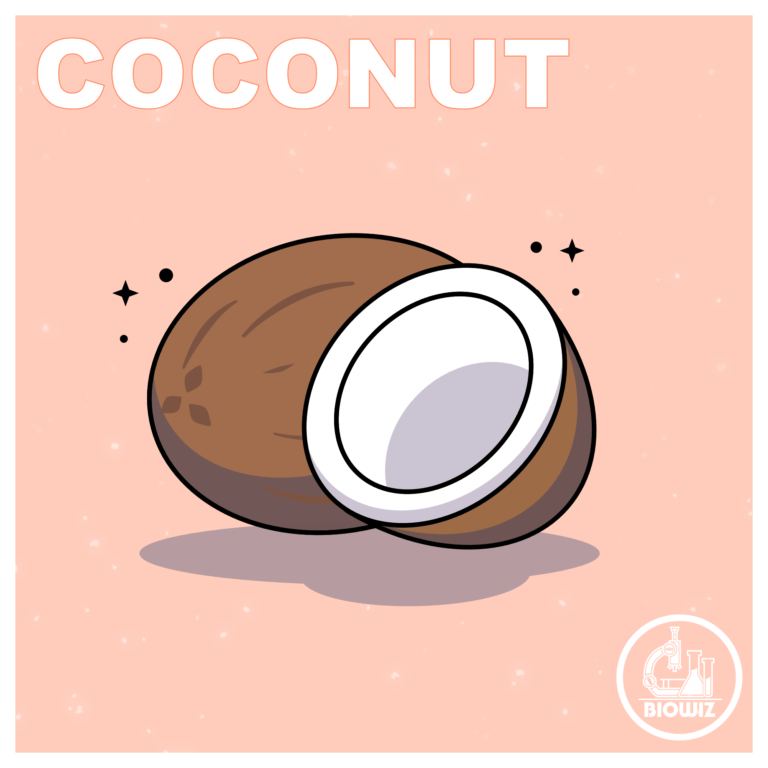
NCERT: the coconut water from a tender coconut is nothing but free-nuclear endosperm, made up of thousands of nuclei, and the surrounding white kernel is the cellular endosperm. As the fruit matures, the free nuclei get walls, so the kernel thickens and the water decreases.
The coconut fruit (drupe)
- The fruit wall (pericarp) is differentiated into three layers:
- Epicarp – the outer, smooth, thin skin.
- Mesocarp – the middle, thick and fibrous layer (the husk). This gives coir.
- Endocarp – the inner, hard and stony shell, which encloses the single seed.
- The seed consists of a thin brown seed coat (testa), the endosperm (kernel and water) and a small embryo.
- The endocarp has three “eyes” (germ pores) at one end. The embryo lies just below the one soft eye, through which the seedling comes out during germination.
Mango and coconut are NCERT’s two examples of drupes. In mango, the edible part is the fleshy mesocarp; in coconut, the mesocarp is fibrous, and the edible part is the endosperm. In both, the endocarp is hard and stony.
Other features of the coconut plant
- Habit – a tall, perennial palm tree.
- Root – a fibrous (adventitious) root system, as in most monocots.
- Stem – an unbranched, cylindrical stem, with a crown of leaves at the top.
- Leaves – large, pinnately compound leaves, with parallel venation in the leaflets.
- Flowers – unisexual; male and female flowers are borne on the same inflorescence, so the plant is monoecious. The inflorescence is a spadix, covered by a large bract called the spathe.
- Seed dispersal – by water (hydrochory). This is why coconut palms grow widely along sea coasts.
Coconut in other NEET topics
- Plant growth regulators – coconut milk (liquid endosperm) is rich in cytokinins. NCERT notes that the natural cytokinin zeatin was isolated from corn kernels and coconut milk.
- Plant tissue culture – because of its cytokinins, coconut milk was used in early culture media to promote cell division.
- Economic importance – coir from the mesocarp, edible endosperm, coconut oil from the dried kernel (copra), and leaves for thatching.
Don’t confuse coconut with the double coconut (Lodoicea maldivica, coco de mer), which produces the largest seed in the plant kingdom. Cocos nucifera is the common coconut.