
https://youtu.be/rFruVNQfF30
Classification
- Kingdom – Animalia
- Phylum – Arthropoda
- Class – Insecta
- Order – Blattodea
- Family – Blattidae
- Genus – Periplaneta, Blatta
- Species – more than 4500 species of cockroaches
General points
- Habitat – warm, dark and damp places like kitchens, storehouses and sewers.
- Body size – length 0.6 cm – 7.6 cm; Periplaneta americana – 3.4 cm – 5.3 cm.
- Body shape – dorsoventrally flattened.
- Body colour – usually brown or black; some species have a yellow, red or green body colour.
- Body symmetry – bilateral symmetry.
- Habit – nocturnal, i.e. active and feeding at night.
- Exoskeleton – made up of hard chitinous plates called sclerites.
- Nutrition – omnivores/scavengers; some species of cockroaches show cannibalism.
- The most common species of cockroaches are Periplaneta americana (American cockroach) and Blatta orientalis (Oriental cockroach).
- Cockroaches are considered serious pests and are vectors for several diseases.
NCERT studies Periplaneta americana as the representative insect. Its body is covered by a hard chitinous exoskeleton made of sclerites: the dorsal ones are called tergites and the ventral ones sternites, joined by a thin, flexible arthrodial membrane.
Morphology
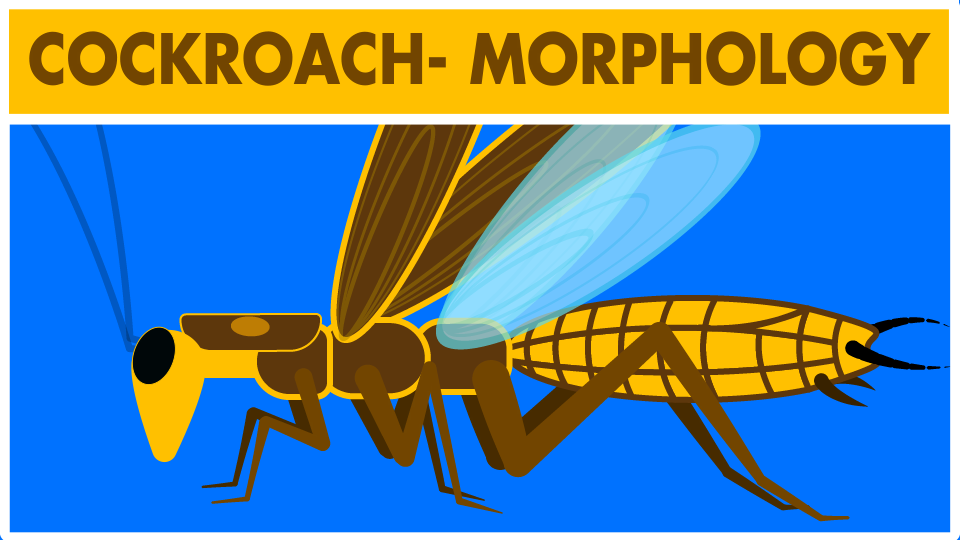
The body is divided into three distinct regions – head, thorax and abdomen.
Head
- Triangular in shape.
- Made up of 6 chitinous plates called cephalic sclerites in the embryo.
- In adults, the cephalic sclerites are fused to form a single head capsule.
- I cephalic sclerite – Occiput
Present at the top of the head and made up of 2 parts called epicranial plates, joined at the epicranial suture. - II cephalic sclerite – Frons
Present below the occiput on the anterior part of the head. - III cephalic sclerite – Clypeus
Present just below the frons on the anterior part. - IV cephalic sclerite – Post-occiput
Present below the occiput on the posterior part of the head. - V cephalic sclerite – Gena
Present on the lateral side. - VI cephalic sclerite – Post-gena
Present inner to the gena. - The head also bears the mouthparts and several sense organs.
NCERT: the head is formed by the fusion of six segments and shows great mobility in all directions due to a flexible neck.
Mouth
- The mouth faces downwards; this is called a hypognathous mouth.
- The mouthparts are of the biting and chewing type.
- They are made up of several parts – labrum, mandibles, maxillae, hypopharynx and labium.
- Labrum – also known as the upper lip, which hangs from the clypeus.
- Mandibles – a pair of mandibles is present inner to the labrum, with grinding and incising regions for cutting the food.
- Maxillae – a pair of maxillae is present beneath the mandibles. They help in the mastication of food and in cleaning the antennae, and each bears a maxillary palp with olfactory receptors.
- Hypopharynx – a median, flexible lobe that acts as the tongue, lying within the cavity enclosed by the mouthparts.
- Labium – also known as the lower lip, formed by the fusion of two parts. A pair of labial palps also arises from the labium and bears sensory bristles.
NCERT: the mouthparts consist of a labrum (upper lip), a pair of mandibles, a pair of maxillae and a labium (lower lip), with the hypopharynx acting as the tongue. Note that the labrum and labium are single, while the mandibles and maxillae are paired.
Sense organs
Antennae
- Paired.
- Multi-segmented; each segment is called a podomere.
- Long and filiform (thread-like).
- Arise from the antennal sockets.
- Bear tactile, thermal and olfactory receptors to monitor the surroundings.
Compound eyes
- Paired.
- Black in colour.
- Bean-shaped (kidney-shaped).
- Placed dorsolaterally on the head.
- Each is made up of about 2000 units called ommatidia.
- Produce mosaic vision.
NCERT: each compound eye has about 2000 hexagonal ommatidia. With these, a cockroach receives several images of an object – mosaic vision – which has more sensitivity but less resolution, and is common during the night (hence also called nocturnal vision).
Ocelli/fenestrae
- Round and pale.
- Present inner and upper to each antennal socket.
- Vestigial simple eyes.
Thorax
- Divided into 3 segments:
- Prothorax
- Mesothorax
- Metathorax
- Each thoracic segment is made up of 4 chitinous sclerites – a dorsal tergum, 2 lateral pleura and a ventral sternum.
- The tergum of the prothorax, called the pronotum, is extended to protect the neck and is the largest of the thoracic terga.
- Each thoracic segment bears a pair of legs, called prothoracic legs, mesothoracic legs and metathoracic legs, arising from the prothorax, mesothorax and metathorax respectively.
- Two pairs of wings, called the forewings and hindwings, arise from the mesothorax and metathorax respectively.
- Forewings/mesothoracic wings – thick, leathery and dark in colour. They are not used for flight, but they protect and cover the hindwings.
- Hindwings/metathoracic wings – thin, transparent, delicate and broad. They are used for flight.
NCERT: the forewings are called tegmina – opaque, dark and leathery, covering the hindwings at rest. The hindwings are transparent, membranous and used in flight. Each walking leg has five segments: coxa, trochanter, femur, tibia and tarsus.
Abdomen
- Made up of 11 segments in the embryo, but reduced to 10 segments in adults.
- The abdomen is broader than the thorax and is dorsoventrally flattened.
- A typical abdominal segment consists of a dorsal tergum, 2 lateral pleura and a ventral sternum, but the 10th segment lacks a sternum.
- In males, the 7th tergum covers the 8th tergum, but all 9 sterna are visible.
- In females, the 7th tergum covers the 8th and 9th terga, and the 7th sternum covers the 8th and 9th sterna.
- Anal cerci – long, thick structures arising from the 10th tergum, which bear tactile receptors and phonoreceptors. Present in both males and females.
- Anal styles – thin, small outgrowths arising from the 9th sternum, which bear tactile receptors. Anal styles are present only in males and are absent in females.
NCERT: in females, the 7th sternum is boat-shaped and, together with the 8th and 9th sterna, forms a brood or genital pouch. A pair of jointed, filamentous anal cerci is present in both sexes, while the short, thread-like anal styles are found only in males – a quick way to tell the sexes apart.