
Introduction
Chromosomes become visible as compact, rod-shaped structures during cell division. Each chromosome is made up of a single, long DNA molecule wrapped around proteins.
In a non-dividing cell, DNA is already present in a coiled and compact form as chromatin. Chromatin is formed when negatively charged DNA is wrapped around positively charged histone proteins. Due to this special packing, it is possible for a very long DNA molecule to fit inside the nucleus. The DNA contains genetic information in the form of sequences of nucleotides called genes. So, it is very important that at the time of cell division, the DNA remains intact and gets evenly distributed among the daughter cells. To ensure this, the chromatin is further condensed into long, compact, rod-shaped structures called chromosomes.
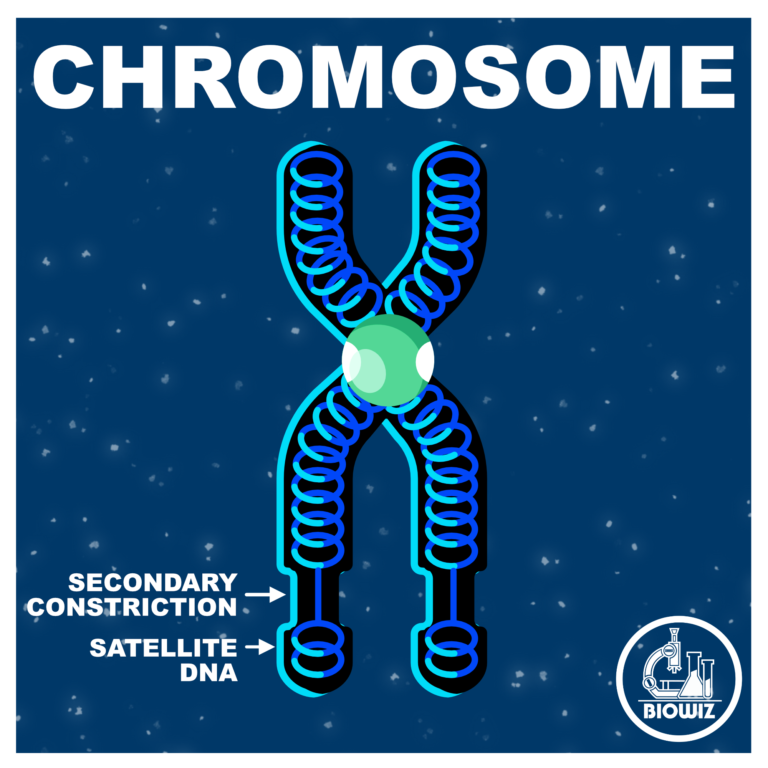
NCERT: a single human cell has about 2 metres of DNA, distributed among its 46 chromosomes (23 pairs). The DNA is wrapped around a unit of eight histone molecules (a histone octamer) to form a nucleosome, which holds about 200 bp of DNA.
Structure of chromosome
Chromatid
Each chromosome consists of either a single chromatid or a pair of chromatids (depending on the phase of the cell cycle). When a pair of chromatids is present in a chromosome, these are called sister chromatids, as their DNA content is exactly the same.
Centromere
The centromere is the narrow, constricted part of the chromosome. It bears proteinaceous, disc-like structures called kinetochores, which serve as the site of attachment of spindle fibres during cell division. The centromere is also called the primary constriction.
Chromosomes are classified by the position of the centromere into metacentric, sub-metacentric, acrocentric and telocentric types. Read more in Types of Chromosomes.
Arms
The parts of the chromatid present on either side of the centromere are called the arms of the chromosome. A chromosome can have 1–4 arms.
Telomeres
Telomeres are repetitive, guanine-rich DNA sequences located at the ends of chromosomes. In many cells, some part of the telomere is lost every time the DNA is replicated.
A chromosome can have 1–4 telomeres.
Constriction
Secondary constrictions are constricted or narrow regions found at any point on the chromosome other than the centromere.
The secondary constriction marks the site of a nucleolar organiser region (NOR), a region containing multiple copies of the 18S and 28S ribosomal RNA genes, which produce the ribosomal RNA required by ribosomes.
The part of the chromosome present beyond the secondary constriction is called the satellite, and chromosomes bearing it are called SAT chromosomes.
Don’t confuse the satellite (the small segment beyond the secondary constriction) with satellite DNA, which is a type of repetitive DNA sequence used in DNA fingerprinting.