
Classification
- Kingdom – Plantae
- Division – Magnoliophyta (Angiospermae)
- Class – Magnoliopsida (Dicotyledonae)
- Order – Rosales
- Family – Rosaceae
- Genus – Pyrus
- Species – Pyrus malus
Important points
- Apple fruits are categorised as false fruits.
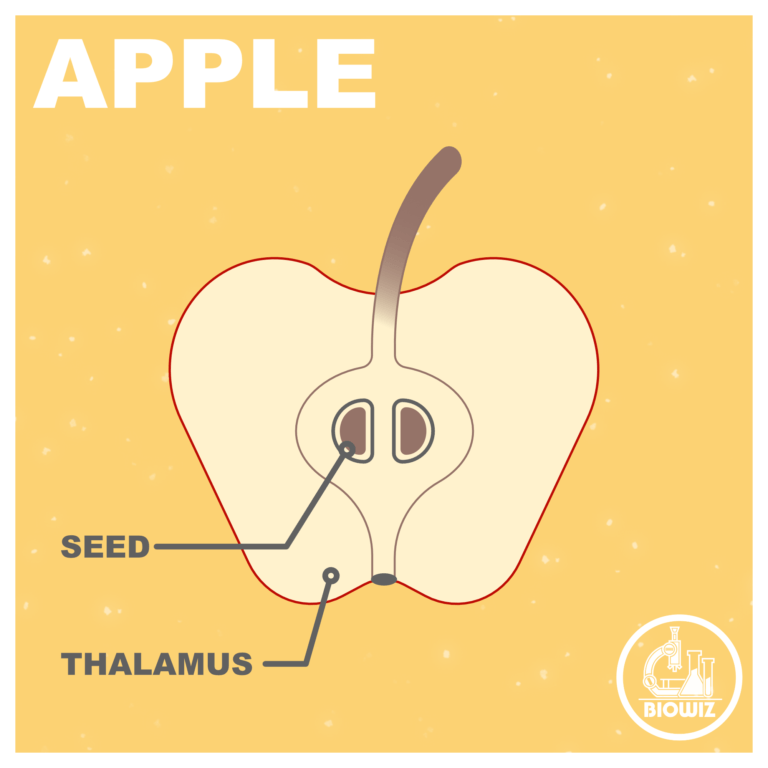
- Along with the ovary, the thalamus is also involved in the formation of the fruit.
- The thalamus becomes the edible part of the fruit after fertilisation.
- The apple fruit lies in the pome category of fleshy fruits.
- Most members of the Rosaceae family have perigynous flowers, but in apple the thalamus fuses with the ovary, so the ovary is inferior and the flower is epigynous. This is why the thalamus becomes the fleshy part of the fruit.
- The seeds can be formed by apomixis (recurrent agamospermy).
NCERT: in a few species such as apple, strawberry and cashew, the thalamus also contributes to fruit formation. Such fruits are called false fruits. Most fruits develop only from the ovary and are called true fruits.
Don’t confuse the family with the fruit: NCERT gives plum, rose and peach (all Rosaceae) as examples of perigynous flowers, and guava, cucumber and the ray florets of sunflower as examples of epigynous flowers (inferior ovary). Apple, like guava, has an inferior ovary.
True fruit and false fruit
| Feature | True fruit | False fruit |
|---|---|---|
| Develops from | Ovary only | Ovary + other floral parts (mainly the thalamus) |
| Edible part | Usually the pericarp or seed | Often the fleshy thalamus |
| Examples | Mango, coconut, tomato, grape | Apple, pear, strawberry, cashew |
The apple fruit (pome)
- A pome is a fleshy fruit in which the ovary is surrounded by the swollen, fleshy thalamus.
- The fleshy part that we eat is mainly the thalamus.
- The actual fruit, formed from the ovary, is the core in the centre. Its inner wall (endocarp) is thin and papery (cartilaginous), and it encloses the seeds.
- Pear is another common example of a pome.
Edible parts to remember: apple – fleshy thalamus; mango – mesocarp; coconut – endosperm; cashew – fleshy pedicel (false fruit) and seed; strawberry – fleshy thalamus, with the true fruits (achenes) on its surface.
Apple and apomixis
- Apomixis is the formation of seeds without fertilisation. It is a form of asexual reproduction that mimics sexual reproduction.
- Since there is no meiosis and fertilisation, the plants formed from apomictic seeds are genetically identical to the parent plant (clones).
- Recurrent agamospermy is a type of apomixis in which the embryo develops from a diploid egg cell or another diploid cell of the ovule, without fertilisation.
NCERT: apomixis is seen in some species of Asteraceae and grasses. It is important for the hybrid seed industry, because if hybrids are made apomictic, the hybrid characters will not segregate in the progeny, and farmers can keep using the same hybrid seeds year after year.