
Important points
- Polysaccharides are polymers of monosaccharides having more than 10 units.
- Polysaccharides are biomacromolecules.
- Polysaccharides, even though classified as saccharides, are not sweet in taste.
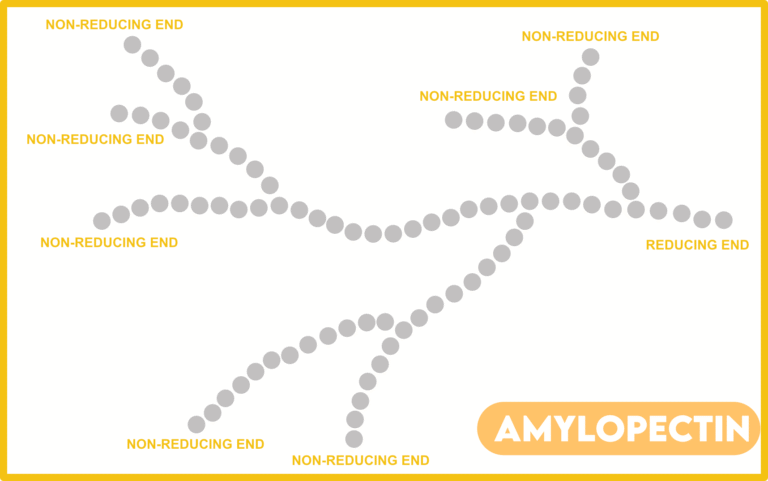
- During the formation of a polysaccharide, new monosaccharide residues are added at the non-reducing end of the chain.
CLASSIFICATION OF POLYSACCHARIDES
On the basis of the type of repeating units
- HOMOPOLYSACCHARIDES
- HETEROPOLYSACCHARIDES
On the basis of their role
- STRUCTURAL POLYSACCHARIDES
- STORAGE POLYSACCHARIDES
1. Structural polysaccharides
CELLULOSE
- Cellulose is a homopolymer of β-glucose.
- The β-glucose units are joined by β-(1,4) glycosidic bonds.
- Cellulose is a linear, straight-chain molecule.
- Cellulose is the most abundant organic molecule on Earth.
- Found in the cell wall of plants and in the spores of some slime moulds.
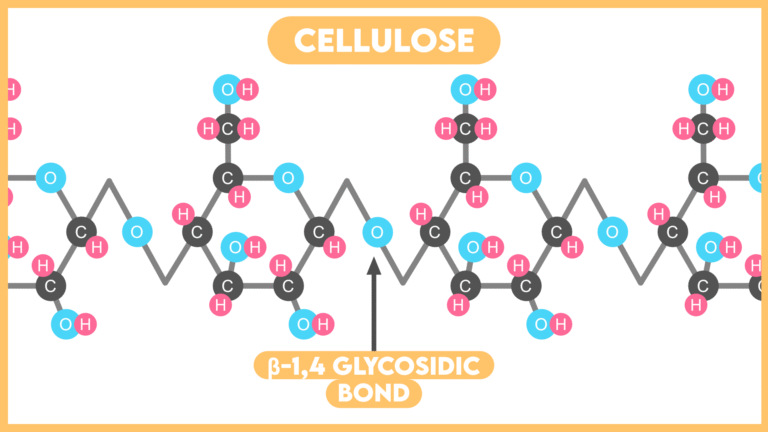
Humans cannot digest cellulose because we lack the enzyme cellulase, which breaks β-(1,4) bonds. Ruminants digest it with the help of microbes in their gut.
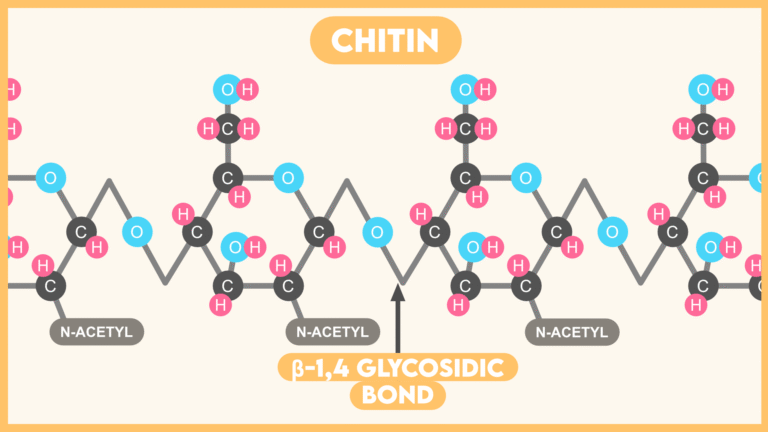
CHITIN
- Chitin is a homopolymer of N-acetyl glucosamine (NAG), an amino sugar with an N-acetylated amino group.
- The NAG units of chitin are joined by β-(1,4) glycosidic bonds.
- Chitin is also a linear, straight-chain molecule, but it can form helices in its secondary form.
- Chitin is the second most abundant organic matter on Earth.
- Found in the cell wall of fungi and the exoskeleton of arthropods.
PEPTIDOGLYCAN
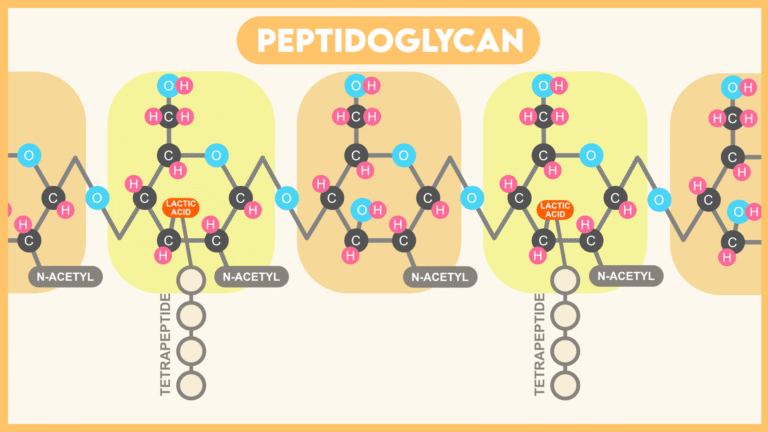
- Peptidoglycan is a heteropolymer of N-acetyl glucosamine (NAG) and N-acetyl muramic acid (NAM) [both NAG and NAM are amino sugars].
- The NAG and NAM units of peptidoglycan are joined by β-(1,4) glycosidic bonds.
- Found in the cell wall of eubacteria.
OTHER STRUCTURAL POLYSACCHARIDES
- Pectins
- Hemicellulose
2. Storage polysaccharides
STARCH (AMYLUM)
- Starch is a homopolymer of α-glucose units.
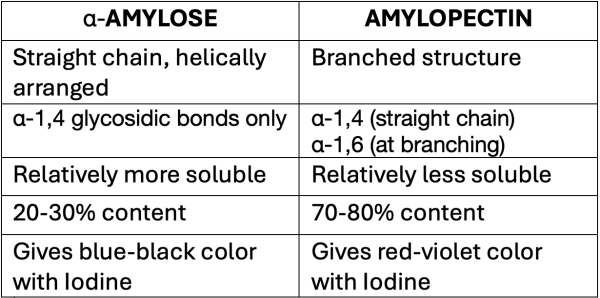
- The α-glucose units are joined by α-(1,4) glycosidic bonds in the chains and α-(1,6) glycosidic bonds at the branch points (in amylopectin).
- It is the reserve food in plants and is found as insoluble granules in chloroplasts and amyloplasts.
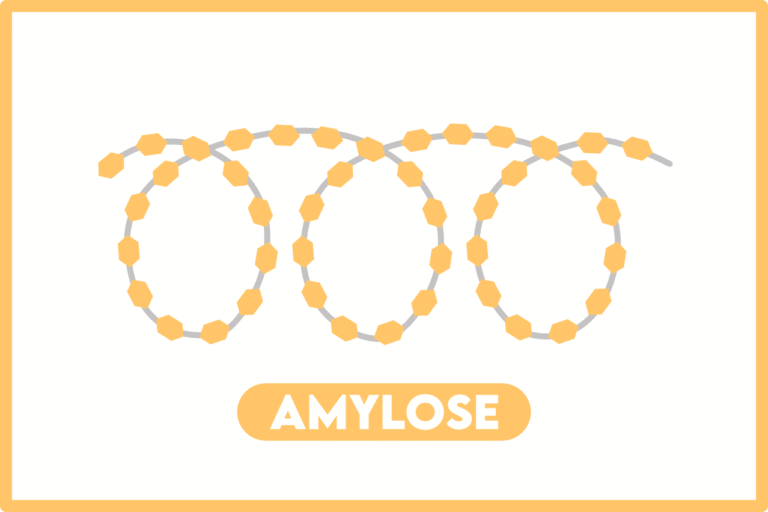
- Starch is made up of α-amylose and amylopectin.
GLYCOGEN
- Glycogen is a homopolymer of α-glucose units.
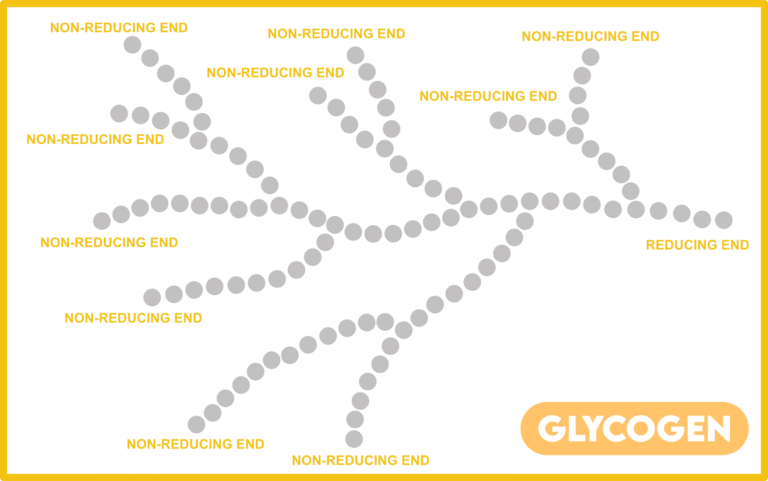
- Glycogen is similar in structure to amylopectin but is relatively more branched.
- Glycogen is the reserve food in most bacteria, fungi and animals.
- Gives a red-violet colour with iodine.
- Number of non-reducing ends in a glycogen molecule = number of branch points + 1.
- Number of reducing ends = 1 (right side).
Iodine test: starch gives a blue-black colour because iodine fits inside the amylose helix, while glycogen gives a red-violet colour. Cellulose does not react, as it has no helices to hold iodine.
Amylose is unbranched, with only α-(1,4) bonds. Amylopectin branches about every 24–30 glucose units through α-(1,6) bonds, and glycogen is more branched, about every 8–12 units.
INULIN
- Inulin is a homopolymer of fructose units.
- The fructose units are joined by β-(2,1) glycosidic bonds.
- Stored in the roots of Dahlia and related plants.
- Inulin is a water-soluble polysaccharide.
- Inulin is not metabolized in the human body and hence is used for the kidney function test.