
Diatoms are microscopic, single-celled photosynthetic protists with glass-like silica walls, found in fresh and sea water.
Description
- Kingdom – Protista
- Phylum – Chrysophyta/ Bacillariophyta
- Unicellular eukaryotes.
- Photosynthetic.
- Chief producers of the oceans.
In NCERT, diatoms are placed with the desmids (golden algae) in the group chrysophytes. Most are microscopic and float passively in water currents as plankton.
Features
Habitat
- Mainly aquatic (both freshwater and marine).
- A few are terrestrial.
Body color
- Golden-brown (mainly).
Cell wall
- Cellulosic cell wall with depositions of silica, called the frustule.
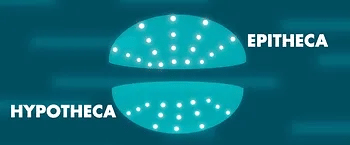
- The frustule is transparent and glass-like, and made up of two halves, i.e. the epitheca and the hypotheca.
- The body has a soapbox-like structure.
Flagella
- Absent in the vegetative phase.
- May be present in gametes.
- Diatoms float passively with water currents.
- A few can show mucilage propulsion.
Vacuole
- A large central vacuole is present.
Pigments
- Chlorophylls – a and c
- Xanthophylls – diatoxanthin, fucoxanthin, diadinoxanthin
- Carotenes – β-carotene
Food storage
- Oil
- Leucosin (polysaccharide)
Reproduction
- Asexual – The new cells formed by binary fission each take one half of the frustule and use it as the epitheca, and the hypotheca is newly synthesised. Thus, the size of the cells keeps decreasing with each division.
- Sexual – Diatoms enter the sexual stage when the size of the cell becomes too small. As a result, gametes are produced, which fuse to form a diploid zygote called the auxospore, also called the rejuvenescent spore (it restores the original size of the diatom).
Examples
- Centrales – have radial symmetry, e.g. Melosira, Cyclotella.
- Pennales – have bilateral symmetry, e.g. Navicula, Pinnularia.
Special points
- The indestructible cell walls of diatoms are deposited on the sea bed and form diatomaceous earth or kieselguhr.
- Diatomaceous earth is used in:
- Filtration of oils and syrups.
- Polishing of metals.
- Soundproofing.
- Diatoms are present in huge numbers and are the chief producers of the aquatic ecosystem.
Don’t confuse diatoms with dinoflagellates, the other protist group NEET often pairs with them. Dinoflagellates have stiff cellulose plates (not silica), two flagella, and some, like Gonyaulax, multiply so fast that they cause red tides.