
Cardiac muscles are striated, involuntary muscles found only in the wall of the heart.
Important points
- Muscle fibres are cylindrical and branched.
- Intercalated discs are present at the junctions of the cells.
- Striations are present but very faint.
- Cells are uninucleate.
- Cardiac muscles are involuntary.
- They perform slow and rhythmic contractions.
- Cardiac muscles never develop fatigue.
- Location – myocardium of the heart.
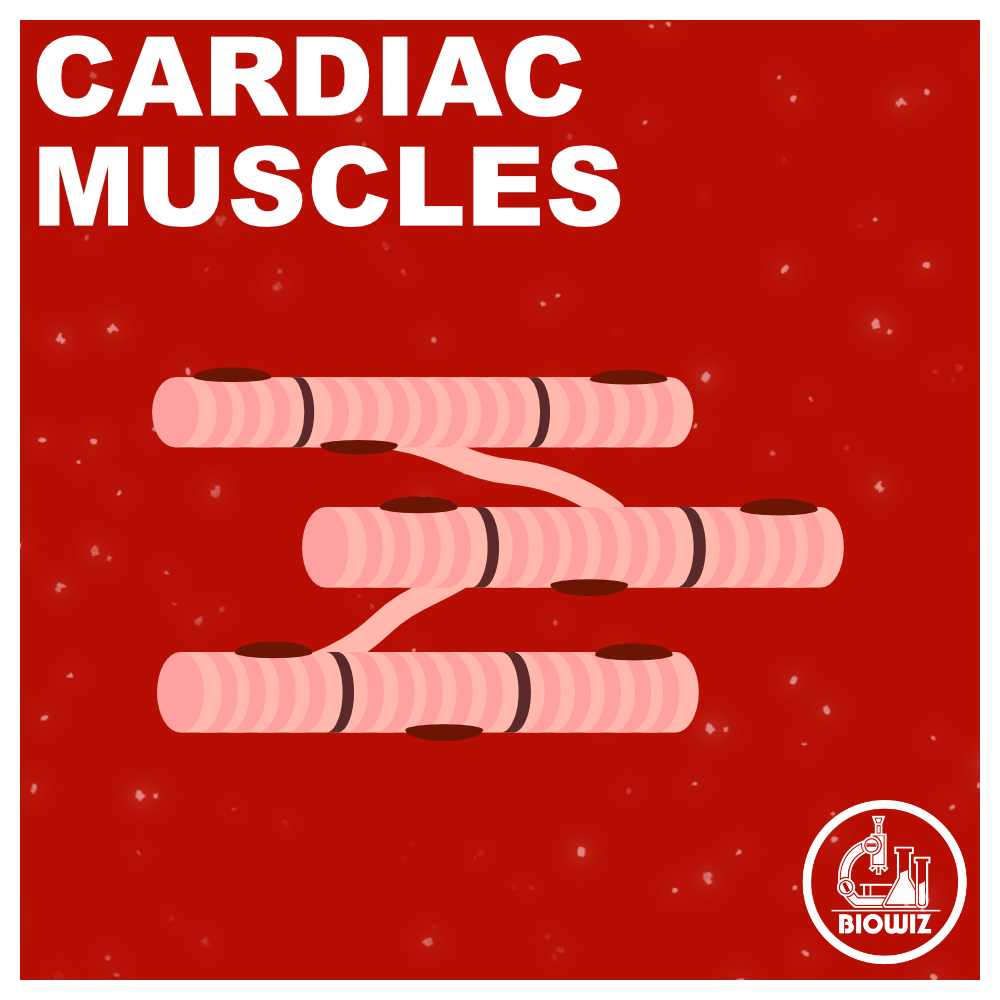
NCERT: cell junctions fuse the plasma membranes of cardiac muscle cells and make them stick together. Communication junctions (intercalated discs) at some fusion points allow the cells to contract as a unit: when one cell receives a signal to contract, its neighbours are also stimulated.
Smooth, skeletal and cardiac muscles
Cardiac muscles are one of the three types of muscles, along with smooth muscles and skeletal (striated) muscles.
| Feature | Smooth | Skeletal | Cardiac |
|---|---|---|---|
| Shape of fibres | Spindle-shaped | Long, cylindrical | Cylindrical, branched |
| Striations | Absent | Present | Present |
| Nuclei | One, central | Many, peripheral | One or two, central |
| Control | Involuntary | Voluntary | Involuntary |
| Fatigue | Does not fatigue | Fatigues quickly | Does not fatigue |
| Location | Walls of gut, blood vessels, urinary bladder | Attached to bones | Heart wall |
Cardiac muscle is the only muscle that is both striated and involuntary. Its rhythmic contractions start in the heart itself, from the SA node (pacemaker), which is why the human heart is called myogenic.