
What is a tooth?
A tooth is a part of the digestive system which breaks the food into tiny fragments before swallowing. There are about 32 teeth in an adult human. Enamel is ectodermal in origin (other ectodermal structures include hair, nails, skin, etc.), while dentine, pulp and cementum are mesodermal. The first tooth appears in the oral cavity at about 6 months of age. A tooth is anatomically divided into two parts – the crown and the root. The crown is the white portion of the tooth visible in the oral cavity, while the roots are embedded in the alveolar socket.
Parts of a tooth
A tooth is mainly composed of:
- Enamel – It is the outermost layer of the tooth, white in colour and the hardest substance in the human body. It is mainly composed of 96% inorganic substance and 4% organic substance.
- Dentine – It is present just beneath the enamel and is slightly yellowish in colour. It contains 70% inorganic substance, while the remaining 30% is made up of organic and water components.
- Pulp – Pulp is present in the inner core of a tooth. It is soft, vascular and rich in nerve supply. The vitality of the tooth depends upon the condition of the pulp.
- Cementum – It is the substance that lines the root of the tooth and provides fibrous attachment.
- Periodontal ligaments – These are composed mainly of type 1 collagen fibres, divided into 5 groups. They mainly function to bear the masticatory forces and provide attachment of the tooth in the alveolar socket.
Enamel is secreted by ameloblasts, and dentine by odontoblasts. The hard chewing surface of the teeth, made of enamel, helps in the mastication of food.
Types of teeth
On the basis of function
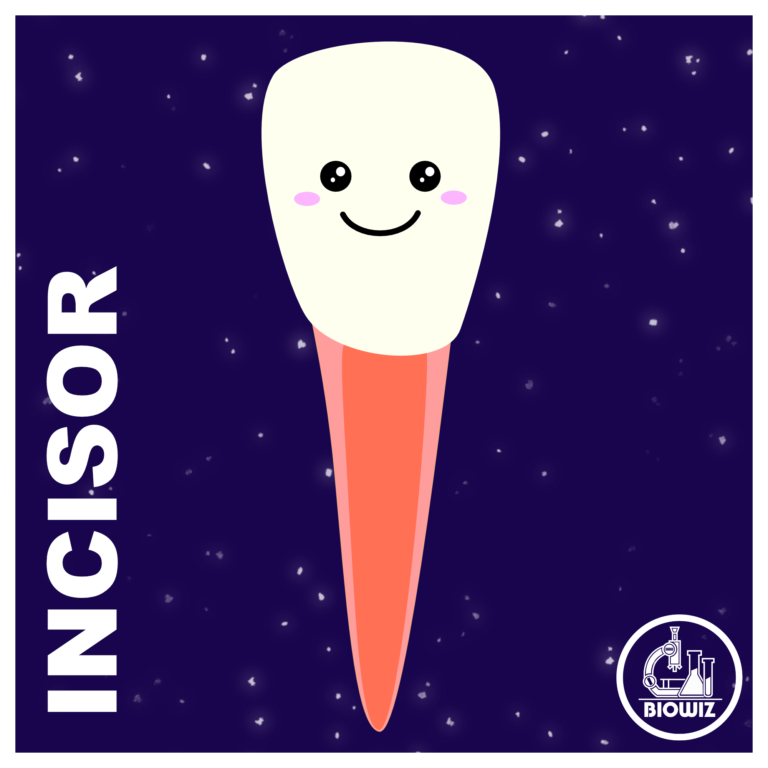
- Incisors – These are front teeth that help in biting and cutting food.
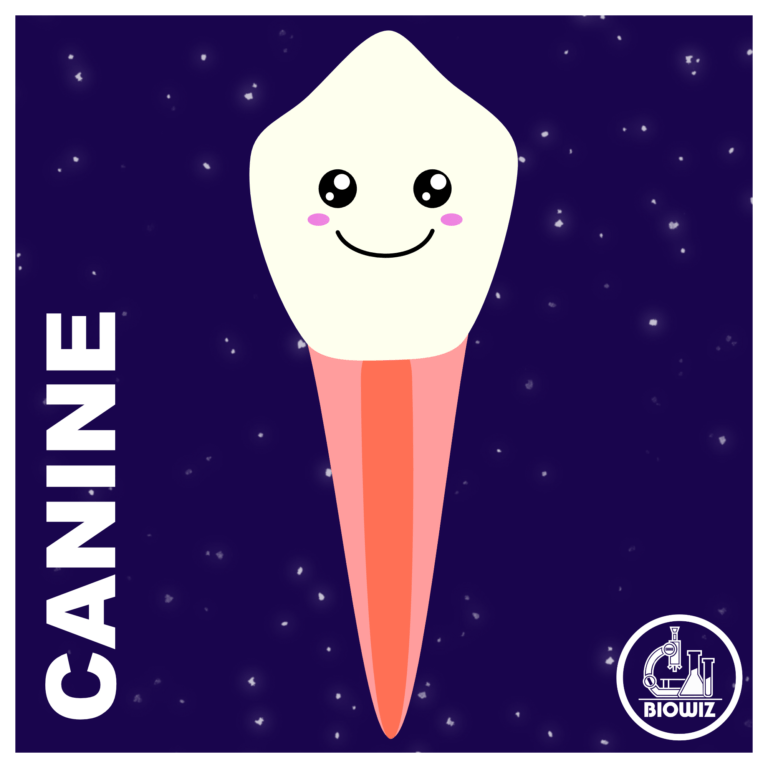
- Canines – These teeth are placed at the corners of the mouth; they are sharp and help tear food.
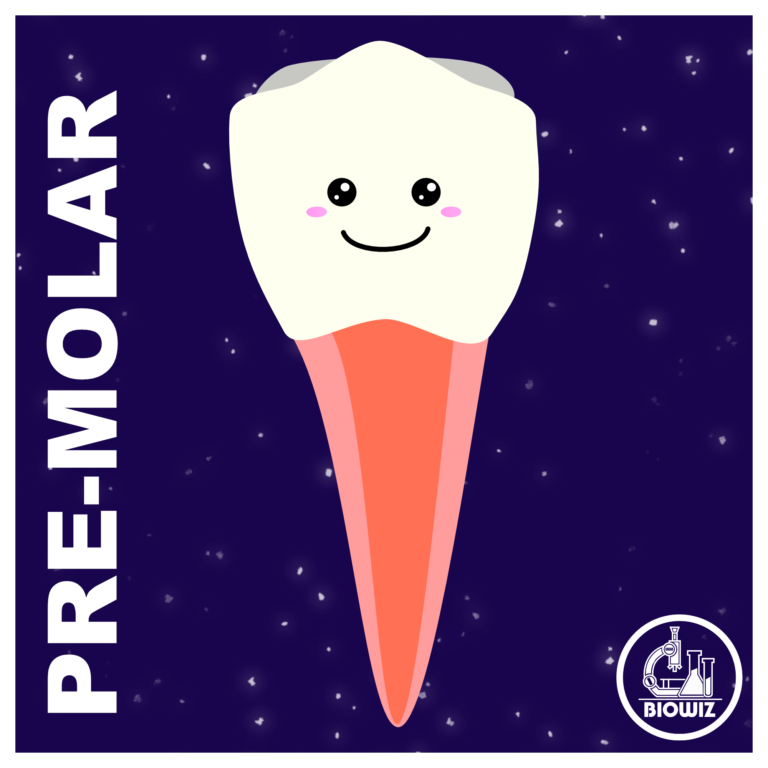
- Premolars – These are present behind the canines; these teeth help grind the food.
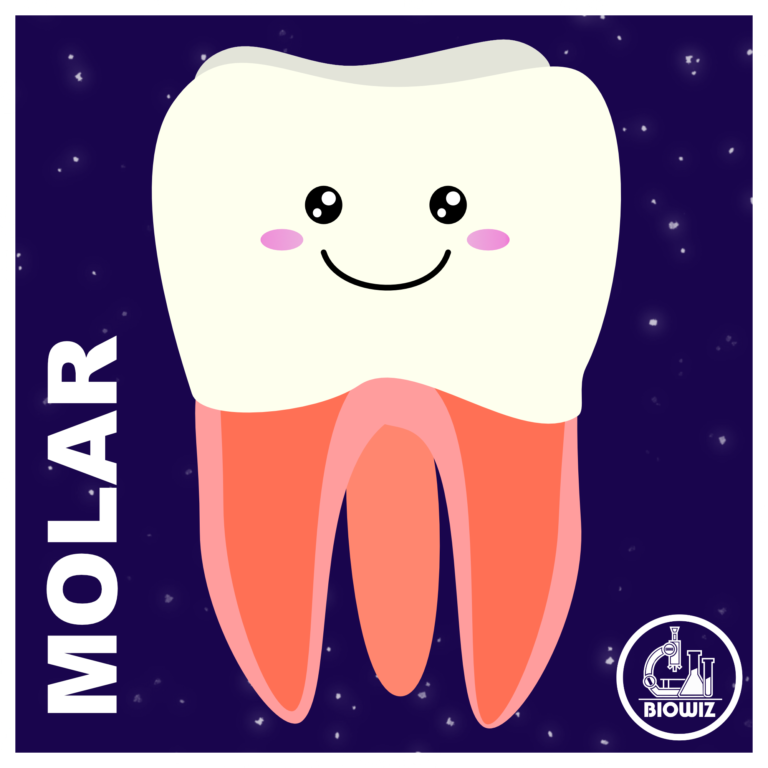
- Molars – These are located behind the premolars; these help grind and chew food properly.
On the basis of sets of dentition
- Monophyodont – Presence of only one set of teeth for the entire life.
- Diphyodont – Presence of two sets of dentition. Example – humans.
- Polyphyodont – Presence of more than two sets of dentition.
On the basis of shape of tooth
- Homodont – All teeth have the same shape, without distinction.
- Heterodont – Presence of different groups of teeth. E.g. incisors, canines, premolars, molars.
On the basis of shape of cusps
- Bunodont – Teeth with low, rounded cusps. E.g. humans, pigs.
- Haplodont – Simplest cone form of teeth with a single root. Only simple hinge movements of the jaw are seen. E.g. reptiles (crocodile).
- Triconodont – Three cusps arranged in a line, with the largest cusp in the centre. E.g. early mammals.
- Tritubercular stage – Three cusps arranged in a triangle form.
- Quadritubercular stage – A fourth cusp is formed, and an occlusal contact relationship between the upper and lower jaw is established.
Human dentition
Humans have two sets of dentition, viz. deciduous dentition and permanent dentition.
1. Deciduous dentition
Deciduous dentition is also known as milk teeth due to its resemblance to the colour and refractive index of milk. It consists of incisors, canines and molars.
- Eruption time – 6 months – 2.5 years
- Tooth formula – 2102/2102
2. Permanent dentition
It is slightly yellowish in colour. The colour of permanent dentition depends on the translucency of the enamel. It consists of incisors, canines, premolars and molars.
- Eruption time – 6 years onwards
- Tooth formula – 2123/2123
Human teeth are thecodont (embedded in sockets of the jaw bones), diphyodont and heterodont. The dental formula 2123/2123 gives the teeth in one half of each jaw: 8 × 4 = 32 teeth.
Differences between deciduous dentition and permanent dentition
| Features | Deciduous dentition | Permanent dentition |
|---|---|---|
| Number | 20 | 32 |
| Colour | Milky white | Slightly yellowish |
| Enamel | Thinner (about 1 mm) | Thicker (about 2–3 mm) |
| Mamelons | Absent | Present |
| Shape of root | Longer, more slender | Shorter, bulbous |
| Flaring of root | Prominent flare | Less flaring |
| Pulp chamber | Larger | Smaller |
| Root canals | More ribbon-like | Well defined |