
What are antibodies?
Antibodies or immunoglobulins are γ-globulins which are produced in response to antigenic stimulation. These react specifically with the antigens which stimulated their production. All antibodies are Igs, but not all Igs are antibodies.
How are antibodies produced?
Antibodies are mainly produced by plasma cells (up to 2000 molecules per second) and to some extent by B-lymphocytes also. These antibodies can be either bound to the membrane or free.
The first antibodies produced following an infection (primary response) are IgM, becoming detectable about 1 week after infection and persisting for about 6 weeks. About 2 weeks after infection, IgG antibody is produced and is long-lasting. IgG is the main antibody formed in the secondary response.
The primary response (first encounter with an antigen) is of low intensity. Because of memory cells, a later encounter with the same antigen produces a much faster and stronger secondary (anamnestic) response. NCERT calls the antibody-mediated response the humoral immune response, as the antibodies are found in the blood.
Structure of antibodies
The basic structural unit of all immunoglobulins is a Y-shaped molecule made of four polypeptide chains. An antibody molecule consists of the following parts:
- Heavy chains
Two heavy chains of 50,000 daltons molecular weight. - Light chains
Two light chains of 25,000 daltons molecular weight. - Disulphide bonds
The light and heavy chains are joined by a single disulphide bond, while the two heavy chains are linked by two disulphide bonds. - Constant and variable regions
Each chain of the antibody consists of a constant and a variable region. - Fragment antigen binding (Fab) and fragment crystallisable (Fc)
The Fab binds to specific antigens in a lock and key pattern, forming an antigen-antibody complex. The Fc part does not bind to antigen and can be crystallised.
NCERT represents an antibody molecule as H2L2 – two heavy (H) chains and two light (L) chains. The antigen-binding site lies at the tips of the two arms of the Y, formed by the variable regions of one heavy and one light chain.
Types of antibodies
Antibodies can be divided into 5 classes based on their antigenic structure and physico-chemical nature, i.e. IgG, IgA, IgD, IgE and IgM.
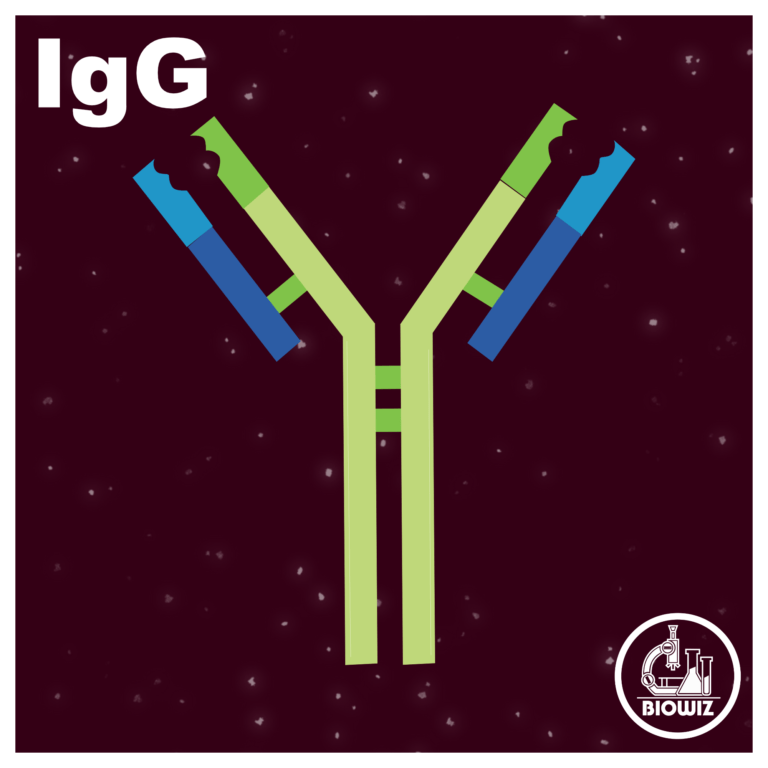
Immunoglobulin G (IgG)
- Most abundant antibody (approximately 75%).
- Occurs as a monomer.
- Found in blood, lymph and intestines.
- Major form of antibody produced during the secondary response.
- It is not produced by the foetus, but it can cross the placental barrier. Hence, it is responsible for the protection of the infant during the first few months of life.
- It usually exhibits high affinity for antigens, leading to efficient neutralisation of toxins.
- IgG suppresses homologous antibody synthesis by a feedback process. This property is utilised to prevent isoimmunisation of an Rh-negative mother bearing an Rh-positive baby, by administering anti-Rh (D) IgG at the time of delivery.
Immunoglobulin A (IgA)
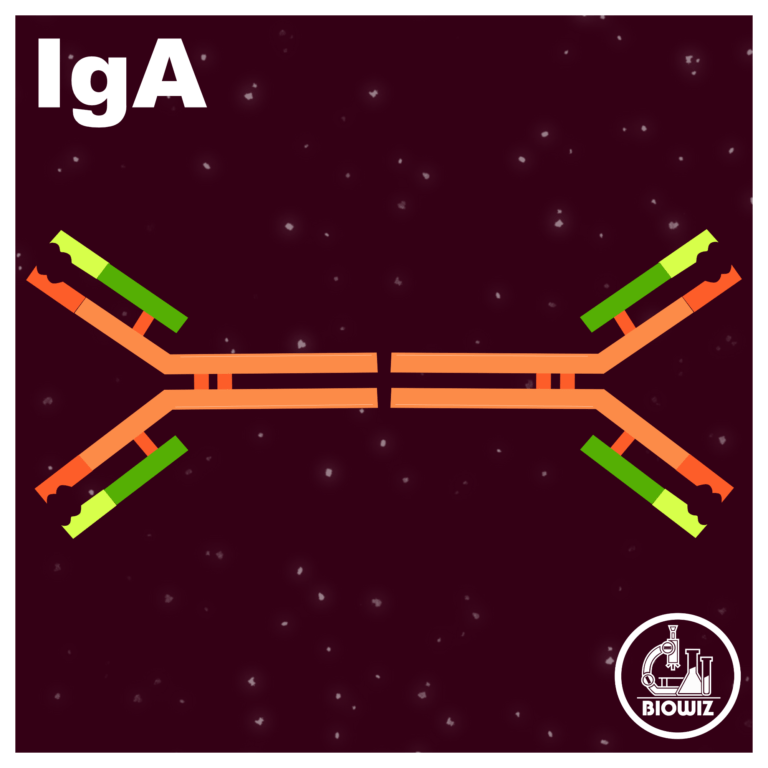
- It is the second most abundant class, approximately 15% of human serum immunoglobulins.
- It exists in two forms – monomeric (in serum) and dimeric (secretory IgA).
- It is predominantly found in secretions such as milk, tears, nasal secretions, saliva, perspiration and serous secretions.
- It plays an important role in local immunity against respiratory and intestinal pathogens.
- Secretory IgA, when present in secretions, prevents the attachment of organisms to epithelial cells, thus preventing adhesion, colonisation and infection.
- Secretory IgA is relatively resistant to digestive enzymes.
NCERT: the yellowish fluid colostrum, secreted by the mother during the initial days of lactation, has abundant IgA to protect the infant. This is an example of natural passive immunity.
Immunoglobulin M (IgM)
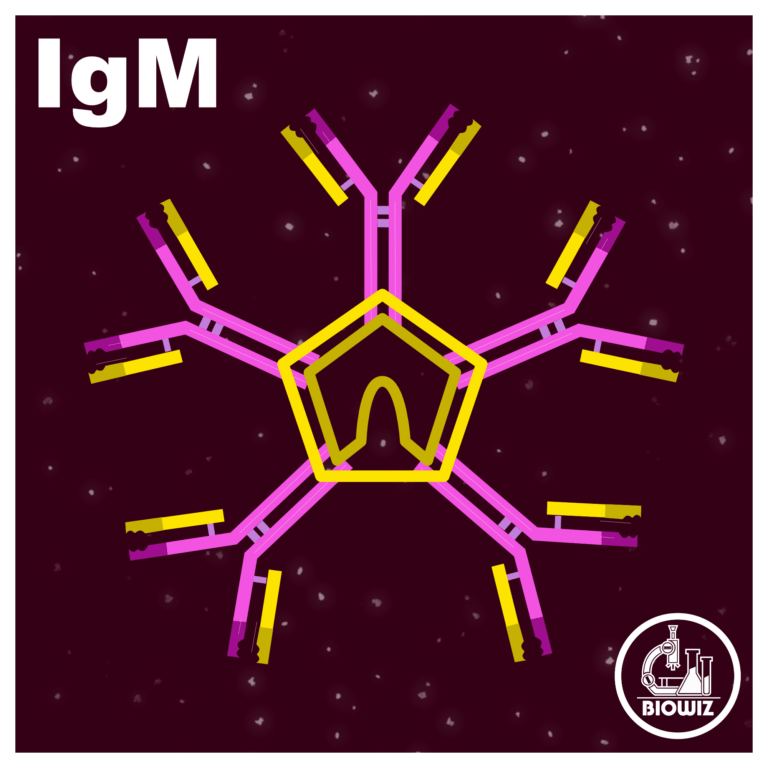
- Forms 5–10% of the total antibodies in the blood.
- Occurs as a pentamer (at least 5 times larger than IgG).
- It is present on the surface of virtually all uncommitted B cells.
- Secreted IgM, being large, remains mostly in the blood and is not found extravascularly in the body.
- IgM is responsible for protection against blood invasion by microorganisms.
- It is the main immunoglobulin in the primary response.
- It is a marker of acute infection.
- It does not cross the placenta, but the foetus synthesises IgM by about 20 weeks of gestation.
- IgM is much more efficient than IgG in its ability to fix complement, promoting the lysis and death of most Gram-negative bacteria.
Immunoglobulin D (IgD)
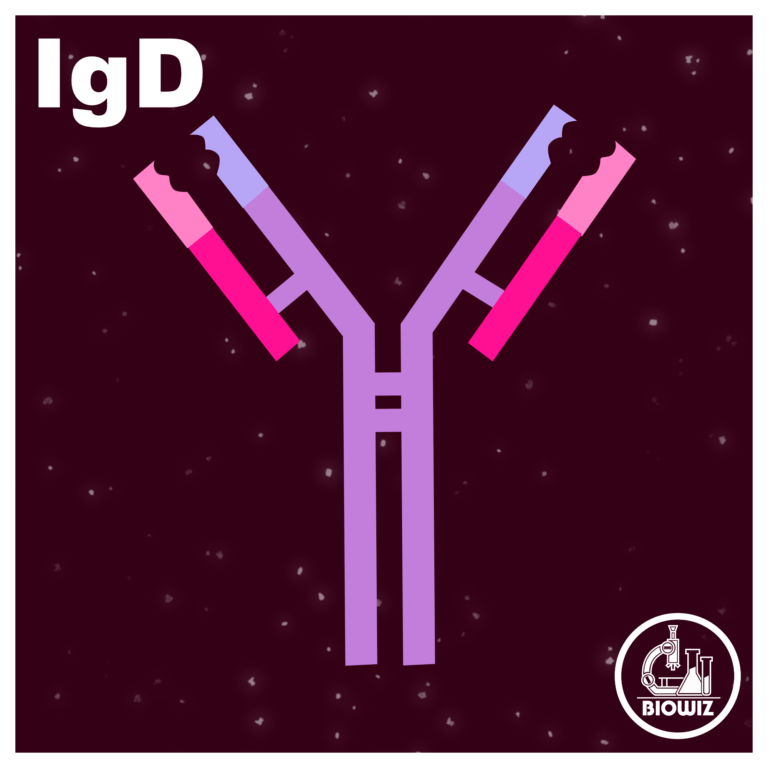
- About 0.2% of the total antibodies in the blood.
- Occurs as a monomeric immunoglobulin.
- It is present on the surface of B lymphocytes which are destined to differentiate into antibody-producing plasma cells.
- It does not cross the placenta.
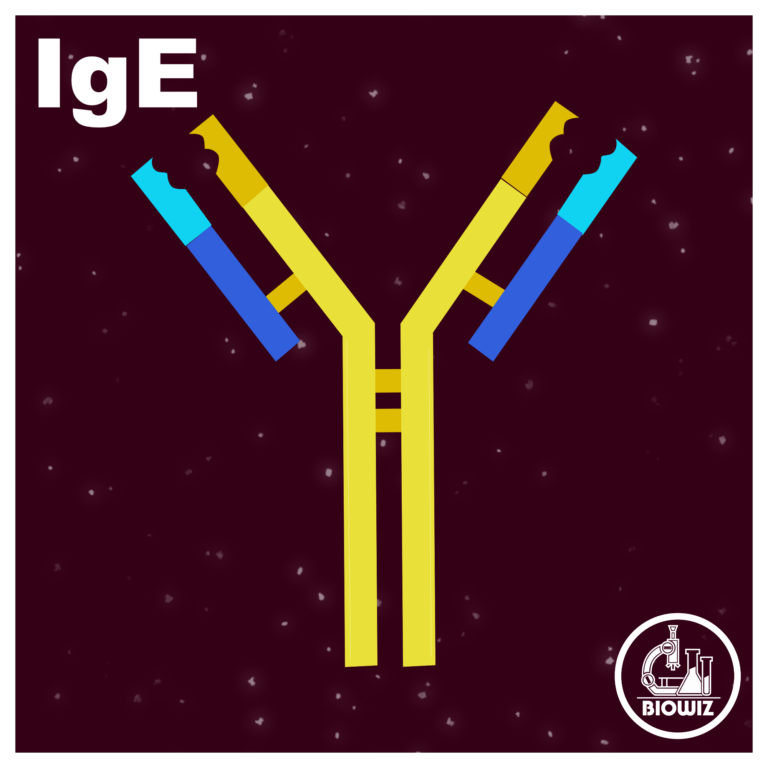
Immunoglobulin E (IgE)
- Less than 0.1% of all the antibodies in the blood.
- It is also a monomeric immunoglobulin.
- IgE is fixed to the surface of mast cells and basophils, and when a specific antigen binds to the IgE, histamine and serotonin are released.
- It is chiefly produced in the linings of the respiratory and intestinal tracts.
- It is heat-labile and gets inactivated by heating at 56 °C for 30 minutes.
- IgE is involved in allergic and hypersensitivity reactions, and also provides protection against parasitic worms.
- It does not cross the placenta.
Quick revision: IgG – most abundant, crosses the placenta; IgA – in secretions and colostrum; IgM – largest (pentamer), first in the primary response; IgE – allergy, binds mast cells; IgD – on the surface of B cells.